
Not all seconds are equal: Why Attentive Seconds are the foundation of better creative and media decisions

Learn how AttentionAI uses active, passive and non-attention seconds to show whether ads are truly seen, processed and given the chance to work.

Attention is often talked about as though it is one thing.
It isn’t.
An ad can be on screen. A person can be nearby. The video can be playing. The impression can be counted. But none of that tells us whether someone was actively looking at the ad, whether they were only loosely aware of it, or whether their attention had disappeared completely.
That distinction matters.
Because in advertising, seconds only become valuable when they give the brand a chance to be seen, processed and remembered.
This is why one of the most important metric groups in AttentionAI is Attentive Seconds: the breakdown of how much time people spend in active attention, passive attention and non-attention.
These metrics help marketers move beyond asking “was the ad served?” or “did the video play?” and start asking a more useful question:
What kind of human attention did this ad actually earn?
What are Attentive Seconds?
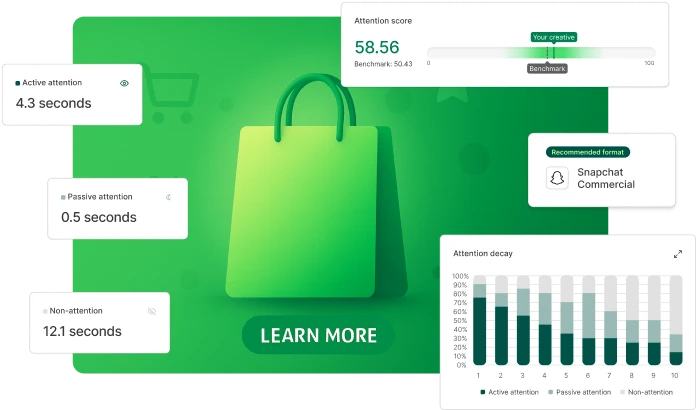
Within AttentionAI, Attentive Seconds show the average amount of time viewers spend in three attention states:
Active attention
The number of seconds viewers had their eyes directly on the ad.
Passive attention
The number of seconds viewers had their eyes on the screen, but not directly on the ad.
Non-attention
The number of seconds viewers were not looking at the screen at all.
Together, these metrics provide a clearer read on how an ad is experienced. They show not just whether an ad had the opportunity to be seen, but whether viewers were actually watching it, loosely exposed to it, or not attending at all.
That makes Attentive Seconds a practical starting point for understanding creative performance, media suitability and the realistic chance an ad has to build memory.
Why active attention matters
Active attention is the most direct signal that an ad is being looked at.
It represents eyes-on-ad time: the moments where the viewer is visually focused on the creative and the brand has the clearest opportunity to land a message.
This is particularly important when an ad is trying to communicate something new, introduce a product, build a distinctive brand asset, or shift perception. In those moments, attention quality matters. It is not enough for an ad to be technically present. It needs to be actively processed.
Within AttentionAI, average active seconds help answer a simple but powerful question:
How many seconds were eyes actually on the ad?
That question can change the way teams assess creative. A high-performing ad is not just one that plays to completion or meets a platform’s viewability threshold. It is one that earns enough active attention to give the message a chance to work.
Why passive attention still has a role
Passive attention should not be dismissed.
There are moments when an ad may still contribute value even when the viewer is not looking directly at it. Passive attention can help reinforce familiarity, support distinctive assets, or maintain brand presence in the background, particularly for well-established brands.
But passive attention is not the same as active attention.
If active attention is the moment where the ad is being directly watched, passive attention is more like the edge of awareness. The ad is present, but the viewer’s focus is elsewhere.
That distinction is useful. It helps marketers understand whether a campaign is earning focused engagement or relying more heavily on background exposure.
AttentionAI’s average passive seconds help answer:
How many seconds were eyes on the screen, but not on the ad?
That can be especially valuable when comparing platforms and formats. Some environments may generate a reasonable amount of passive exposure but very little active attention. Others may create fewer impressions but a much higher quality of viewing.
The job is not always to eliminate passive attention. It is to understand what role it is playing, and whether it is enough for the outcome the campaign is trying to achieve.
Why non-attention is the hidden cost
Non-attention is often the most uncomfortable metric.
It shows the time where the ad was on screen, but the viewer was not looking at the screen at all.
In other words, the ad may have been delivered, counted and paid for, but it had no real chance to work in that moment.
This is where attention measurement becomes commercially important. Non-attention exposes the gap between delivery and human impact. It helps explain why media can appear efficient on paper while still failing to create meaningful outcomes.
AttentionAI’s average inactive seconds help answer:
How many seconds were eyes off screen?
For marketers, this is a critical diagnostic. If non-attention is high, the issue may not be the creative idea alone. It may be the media environment, the format, the placement, the opening structure, or the speed at which attention decays.
Knowing that allows teams to make better decisions before spend is committed.
The job to be done: understand whether creative has a real chance to work
The core use case for Attentive Seconds is simple:
To understand whether an ad has enough quality attention to do the job it was designed to do.
This is particularly useful in three common planning scenarios.
First, when assessing creative strength. Attentive Seconds help determine whether an asset is earning focused attention or simply appearing in front of people.
Second, when matching creative to media. The same creative can behave very differently across formats. An asset that earns strong active attention in one environment may struggle in another where attention drops quickly or viewers are more distracted.
Third, when balancing short-term and long-term objectives. Performance-led creative may need to land quickly and efficiently, while brand-building creative often needs enough active attention to build memory structures over time. Attentive Seconds help show whether the media environment gives each type of creative a realistic chance to succeed.
Turning seconds into better decisions
The value of Attentive Seconds is not just in the numbers. It is in what the numbers help teams do differently.
If active attention is low, the creative may need a stronger opening, clearer branding, simpler messaging or a better fit with the platform.
If passive attention is high but active attention is low, the ad may be present but not compelling enough to pull focus.
If non-attention is high, the placement or format may not be giving the creative a fair chance to work.
These insights can inform creative development, media planning, platform selection and pre-campaign optimisation.
Instead of waiting for performance results after a campaign has run, teams can use AttentionAI to understand attention before media spend is committed.
Why this matters for AttentionAI
AttentionAI is built on the idea that attention should not be treated as a vague post-campaign concept. It should be a practical input into how creative and media decisions are made.
Attentive Seconds are the foundation of that.
They help brands and agencies understand how much active, passive and non-attention an ad is likely to generate across different platforms and formats. From there, teams can assess whether the creative is strong enough, whether the media environment is suitable, and whether the campaign has a realistic chance to build memory, recognition and response.
This is where AttentionAI becomes more than a score.
It becomes a decision-making tool.
By breaking attention into seconds, states and behaviours, AttentionAI helps teams see what traditional metrics often hide: whether people are actually watching, how deeply they are engaged, and where attention is being lost.
Because an impression is not an audience.
A view is not always attention.
And not all seconds are equal.
Find out more about AttentionAI and how its ability to create modelled audiences of 20,000 for every ad you upload means you get the most robust, trustworthy and actionable attention data available in-market today.
Not all impressions are equal, and reach doesn’t guarantee engagement. Amplified’s Campaign Strategy tools use real human attention metrics to help you predict and optimise media performance before launch.
Your campaign's already live, great. But even the best executions can benefit from a fresh lens. Amplified’s in-flight attention measurement gives you clear, science-backed insights into how your creative and placements are performing while there's still time to level-up results.
Through bespoke research studies, we help brands, agencies and platforms measure attention where it matters most, across TV, social, CTV, DOOH and more. This in-depth research helps you ensure that your media investments are seen, engaged with, and delivering true impact.
Test, refine and optimise with attention-first insights. From creative testing to bespoke data analysis, we help brands, agencies and platforms improve performance.
Amplified offers flexible, API-driven integrations, making it easy to activate real human attention data within your existing platforms and tools. Whether you’re an agency, publisher, platform or brand, our integrations ensure attention insights are directly embedded into your workflow, powering smarter, more effective decision-making.
If you’re looking to take attention beyond a one-off study or standard integration, a partnership with Amplified unlocks exclusive access to research, insights, technology and strategic collaboration that transforms how you measure, plan and execute media.



.webp)
.webp)
.webp)
.webp)
.webp)